Sustainability policy
Intro
This policy sets out how Travel Connect manages its social and environmental impact. We are a group of travel brands headquartered in Iceland, where our journey started, with offices in five countries (Iceland, Scotland, Sweden, Italy and Germany), and we sell guided tours and self-drive itineraries across much of Europe. Much of what a traveler experiences, such as the coach, the hotel and the guide, is delivered by the companies we book rather than by us, which is precisely why the choice of supplier matters: we select them carefully, visit them on inspection trips, check their licenses and insurance, and follow up on what our travelers tell us in our feedback surveys.
Our aim is for travel to support the communities that host it and to leave the places people come to see intact. What follows describes the specific actions we take towards that and names where each one applies, rather than setting out general ambitions.
Throughout this policy, "Travel Connect" refers to Travel Connect and its brands (Nordic Visitor, Iceland Travel, Terra Nova, Iceland Tours, Iceland Unlimited, Nine Worlds and Senlinmao) collectively, unless a specific brand, office, or region is named.
In 2026, Travel Connect acquired Haman Group, made up of Haman Travel, Haman Terra Nova, Authentic Scandinavia and Authentic Europe. Haman Group holds its own Travelife Certified recognition. As integration is still in early stages, this Sustainability Policy does not yet cover Haman Group's brands. We will update this page once a shared approach is in place.
One distinction matters for reading what follows. Compliance with the Travelife criteria described below is what an independent auditor has verified. The other figures in this policy are not independently audited: our engagement scores are calculated by Gallup, but from our own employees’ responses; our waste figures come from the monthly reports of our waste contractors; the electricity mixes are as described by the suppliers concerned; and the supplier survey results are what suppliers reported about themselves.
Sustainability certifications
Travel Connect and six of its seven brands (Nordic Visitor, Iceland Travel, Terra Nova, Iceland Tours, Iceland Unlimited and Nine Worlds) hold Travelife Certified recognition. Our seventh brand, Senlinmao, does not hold it. Travelife Certified is the highest recognition level within the internationally recognised Travelife sustainability programme for tour operators and travel agents. Travelife Certified recognition is awarded following a comprehensive independent on-site audit based on the Travelife Certified Standard.
During the audit, it is verified that our company complies with more than 200 mandatory sustainability criteria covering areas including environmental management, climate action, biodiversity, working conditions, human rights, local communities, sustainable supply chain management, customer communication and responsible business practices.
The audit confirms that our sustainability management system and sustainability practices have been demonstrably implemented throughout the entire organisation and comply with the requirements of the Travelife Certified Standard.
To maintain this recognition, our company is recertified every two years to verify that we continue to comply with the requirements of the Travelife Certified Standard.
More information about the Travelife programme, the different recognition levels, the validity of our current Travelife Certified recognition, the assessment process and the publicly available Travelife criteria can be found on the Travelife consumer website: travelife.info/travelers.

Responsible tourism statement
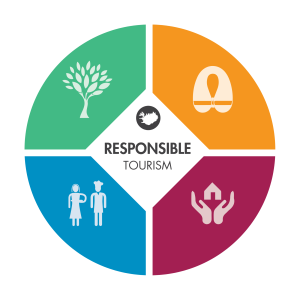
Travel Connect has signed the Responsible Tourism statement ("Ábyrg ferðaþjónusta"), an Icelandic tourism initiative led by the Icelandic Tourism Cluster and the Icelandic Travel Industry Association (SAF), under the patronage of the President of Iceland. It focuses on four goals:
- Protecting and respecting nature
- Ensuring guest safety and fostering respectful interactions
- Upholding and respecting employee rights
- Having a positive impact on local communities
The Travel Connect Fund
We launched the Travel Connect Fund in October 2025 to support social and environmental projects in the places we operate, and we award grants twice a year.
We focus on initiatives that take place in one of the destinations our brands operate in and that address the UN Sustainable Development Goals we prioritise for the Fund: good health and wellbeing (3), gender equality (5), sustainable cities and communities (11), climate action (13) and life on land (15). Much of this work also supports the four goals of the Responsible Tourism statement.
The amounts donated and the projects supported are listed on the Travel Connect Fund page. These donations sit alongside the actions we take to manage our own social and environmental impact, rather than replacing them.
Environmental responsibility
Travel Connect is an Icelandic company, and tourism is a significant part of Iceland’s economy. But our brands run tours across a much wider map, and they share a common thread: an industry that sustains local communities can also wear down the places people travel to see. What follows sets out specific actions we take and where each one applies, rather than general ambitions. These actions do not mean that all our operations, tours, or suppliers have the same environmental performance.
What follows is the footprint our companies and employees can control directly, the daily habits of our offices. That is rather the point: it is the part of our footprint we control directly.
What we can control varies from office to office. We have five: Iceland, Edinburgh, Stockholm, and two smaller ones in Italy and Germany. Only in Iceland and Edinburgh are the building services (energy supply, waste handling and cleaning) ours to choose. Our Stockholm office is our own space, but it sits in a building that arranges those services for its tenants, and the Italy and Germany offices are desks in shared buildings on the same basis. Where a claim below depends on a choice we actually make, we name the offices it covers.
- Going paperless has been the single biggest change to our own administration. Electronic accounting, electronic signatures, and new document procedures have reduced the paper we use.
- Travel documents are the exception: two of our brands, Nordic Visitor and Iceland Unlimited, still print them for travellers. Several things have gone from those documents altogether: the plastic wallets the vouchers used to come in, the printed road books Nordic Visitor once provided, the envelope that carried the welcome letter, and the printed airport welcome signs, which the coach company now displays digitally. What we do still print is printed double-sided.
- Some of our office furniture is bought second-hand, and office equipment is bought new. When we replace furniture we try to pass it on rather than throw it out, either at our Iceland office through a reuse service such as Efnisveitan, or by donating it. Our shared desks in Italy and Germany come furnished.
- At our Iceland and Edinburgh offices, where waste and cleaning are ours to arrange, we separate whatever the local systems will take, and the two lists are not identical.
In Iceland: paper and cardboard, plastic, organic waste, aluminium and glass, with the bottles and cans that carry a return fee collected by the Green Scouts movement.
In Edinburgh: paper and cardboard, organic waste, glass, cans and plastic bottles, our provider there taking bottles rather than mixed plastic. At both offices, the cleaning products we buy are environmentally certified. - For these two offices, our waste companies send us figures every month for each category, so what we throw away is measured rather than estimated. In Stockholm, Italy and Germany, waste handling and cleaning come with the building and we hold no equivalent data.
- From the start, our kitchens have been stocked with reusable glasses, cups, plates and cutlery rather than disposables.
Where we can, we buy office supplies, catering and printing from local businesses.
- Iceland is the fortunate case. We buy our own electricity and central heating there, and both are almost entirely renewable: around 70% hydropower and 30% geothermal for electricity, and around 90% geothermal for central heating. This is how the country works rather than anything we arranged, which is rather the point: the hotels, restaurants and services our travellers use in Iceland draw on the same renewable grid. It is one of the genuine advantages of the destination.
- In Edinburgh, we chose 100% renewable electricity from UK wind farms via SSE Energy Solutions.
- Our Stockholm office uses electricity described by its supplier as 50% wind and 50% hydropower, arranged by the building rather than by us.
- At our Italy and Germany offices the electricity supply is the building owner’s arrangement, so we make no claim about it.
- Sustainability certification in accommodation tends to follow size rather than commitment. Certifying and recertifying costs money and time, so the larger hotel chains we book are often certified while the small country hotels and guesthouses we also book are not. We work with both, and we do not apply a certification requirement that would in practice exclude small, locally owned businesses; keeping them in our itineraries is part of how travellers’ money reaches the communities they visit. Where a supplier does hold a recognised certification we treat it as a good sign, and our supplier survey asks all of them where they stand.
- Some of what we sell brings travellers close to animals, so it is worth being specific about which experiences we offer. We do not sell tours involving captive wildlife or performing animals.
- What we do offer falls into two groups: watching wild animals in their own habitat, such as puffin tours and whale watching; and activities that rely on working animals, such as horse riding, dog sledding and reindeer experiences in Scandinavia.
- Where a supplier’s services involve animals, our agreements include welfare standards covering the health, safety and ethical treatment of those animals.
- Before travellers arrive, we send guidance on travelling responsibly in the destination they are visiting: keeping a distance from wild animals, not feeding them and keeping noise down, along with how to behave around nature reserves and why it matters where they spend their money. This is done by all our brands, with the exception of Senlinmao.
- Visitor pressure is largely decided when an itinerary is designed rather than when travellers arrive, which makes it one of the destination impacts we genuinely influence. We sell both kinds of trip: itineraries built around the best-known sites, and itineraries that deliberately go elsewhere: in Iceland, for example, we run tours through the Westfjords and the north that leave out the south coast altogether. We do not claim to relieve crowding at the busiest places. What we can describe is how we try to spread demand.
- Season is our strongest lever. We run winter departures in most of our destinations, which moves demand away from the summer peak, and where we have no winter product, Italy for example, we promote shoulder-season travel instead.
- Where travellers sleep matters as much as where they go. Much of the accommodation we book sits outside the cities, in smaller towns, country hotels and guesthouses, which spreads both the pressure and the spending. We also sell city breaks, which concentrate rather than spread.
- Beyond our own itineraries, we take part in the work of the Icelandic Travel Industry Association (SAF), including its working groups, and senior people from our brands have served on its boards and committees. Our Iceland Travel Cruise CEO has been on the board of Cruise Iceland for 10 years and currently serves as vice-chairman, helping guide the sector towards more sustainable, high-quality cruise tourism across Iceland. How a destination manages visitor numbers is not something any single operator decides.
Social responsibility
For a tour operator, social responsibility comes down to three groups of people: those we employ, those who work for the suppliers we book, and those who live in the places our travellers visit. Our influence over each is very different, and it diminishes in roughly that order. Travellers themselves are a fourth group, covered under guest safety at the end of this section.
Most of what follows concerns our own employees, because that is where we set the terms directly rather than asking someone else to. Where we describe suppliers or communities, we have tried to say what we actually do rather than what we hope the effect will be.
The UN Sustainable Development Goals most relevant here are good health and wellbeing (3), quality education (4), gender equality (5), and decent work and economic growth (8).
- One of the benefits we’re proudest of is our 7-hour workday, paid as 8 hours, with the lunch break included, not on top. We also build our culture around flexibility: we care about the outcomes people deliver, not rigid hours, so employees can shape their working day around what works for them and their team.
- We also offer employees a workcation: the chance to work away from home for up to 20 days a year, whether that’s spending time at one of our other offices in Europe, visiting family, or simply enjoying a change of scenery.
- Other benefits vary between our offices, shaped by local law and local arrangements. They include parental support, transport allowances, and ongoing training in wellbeing, sustainability and safety.
- Twice a year, in spring and again in autumn, we ask everyone at Travel Connect to complete Gallup’s Q12 employee engagement survey, a standard set of twelve questions used by organisations worldwide, which is what makes the result comparable. Employees answer directly, and Gallup scores the responses against its own global database. In our spring 2026 survey, 91% of our people took part and our mean engagement score was 4.46 out of 5, placing us in the 77th percentile of Gallup’s database, higher than 77% of the organisations Gallup benchmarks. Participation across the last four rounds has run between 88% and 93%. These results cover Travel Connect and all its brands.
- Employee training is coordinated through Travel Connect Academy, which ties learning to both company strategy and individual roles.
- Some courses are mandatory for relevant employees, including new employee orientation days, cyber security, mentor training and sales training. Most of the rest is offered rather than required, and taken up by choice: first aid and safety, weather forecast training, courses for those returning from parental leave, and wellbeing sessions on subjects such as sleep and focus.
- For a company whose staff advise travellers on where to go and what conditions to expect, what our people know is not a side matter. It is part of what we sell.
- Travel Connect's equality policy is based on equal rights for all. It is written to comply with Icelandic law, where the company is based, and our offices in other countries follow local employment law as well.
- We provide an inclusive working environment where employees can balance their work and personal life. Opportunities are also created for all employees to develop and grow. This means that employees are appreciated as individuals, regardless of their gender (and other protected characteristics). All assessments are based solely on relevant experience, skills, education, and the employee’s ability to accomplish their tasks. Our intention is to ensure equal status and equal rights for all genders. We accomplish this by basing decisions regarding remuneration, recruitment, working conditions, assignment of tasks, education and professional development on neutral and professional practices that are not affected by the gender of the employee in question. You can find Travel Connect’s Equal Pay Policy here. To achieve our goals, we regularly measure progress in equality issues. This may include salary analysis, gender ratios and measuring employees’ attitudes towards gender equality at Travel Connect.
- Travel Connect stands firmly against all forms of exploitation and harassment, including forced labour, child labour, human trafficking, and commercial and sexual exploitation. We are committed to protecting the dignity, safety, and human rights of all individuals, with particular attention to the well-being of children and adolescents. For our own people this is a condition of working here. Where we have a signed agreement with a supplier it is contractual rather than aspirational: our agreements prohibit child labour, human trafficking, forced labour and discrimination, and a breach can end the agreement. Where an agreement is not yet in place, it remains what we expect of anyone we work with.
- Travel Connect has been awarded the Jafnvægisvogin (Equality Scale) in 2024 and 2025 for its commitment to gender balance in leadership. While Iceland leads globally in gender equality, corporate leadership remains an area for improvement. The Jafnvægisvogin initiative, led by the Association of Businesswomen in Iceland, recognises companies making measurable progress towards gender balance in management and leadership roles, aiming for a 40:60 gender ratio by 2027. Our executive team already meets that ratio. We believe balanced leadership fosters stronger performance, diverse perspectives, and more inclusive decision-making. And with the initiative’s slogan “Jafnrétti er ákvörðun” (“equality is a decision”) in mind, we remain committed to building a more inclusive future.


- Before we start working with a supplier, our procurement team checks that they are insured and hold the licences their services require. We work with local suppliers that meet our standards for traveller comfort and safety. Where we hold a written agreement, those standards are contractual rather than aspirational.
- Our supplier agreements require compliance with labour law on wages, working hours and working conditions, and opposition to child labour, human trafficking, discrimination, forced labour, corruption and bribery. Suppliers in Iceland must hold the licences and permits required under the Act on the Icelandic Tourist Board (No. 96/2018), provide proof on request, and notify us promptly of any change, suspension or revocation. Failure to maintain them can end the agreement immediately. We reserve the right to carry out safety audits and inspections, with access to documents, facilities, equipment and staff. Beyond these requirements, we encourage suppliers to go further on waste, biodiversity and environmental management.
- Written agreements are sent to suppliers above a set annual booking value, which covers around 80% of the suppliers we work with. Not all of those agreements have been signed yet, and completing them is work in progress, so the requirements above describe our contracted suppliers rather than all of them.
- Contracts are not our only check. We visit suppliers on inspection trips to see the service for ourselves and, for the brands that sell directly to travellers, we run feedback surveys after the trip; where a booking comes through a travel-trade partner, feedback reaches us through that partner. Where a visit or a survey raises something serious, we take it up with the supplier directly.
- We recommend local accommodation, restaurants and experiences to travellers, so more of what they spend stays with the communities they visit.
- We encourage travellers to shop locally and support small businesses along their route, and we listen to feedback from local communities to shape how we guide them.
- As part of our Travelife certification process, we survey our supplier network to understand where they stand on sustainability. Our first survey (January 2026) heard back from around 37% of suppliers surveyed, with over 70% of respondents locally owned and operated, and more than 94% reporting active local sourcing. We’ll repeat this survey annually and use what we learn to offer more targeted support.
- We check all our marketing and promotional material for accuracy, and we only advertise what we can actually deliver.
Guest safety and respectful interactions
- Before travellers set off and while they are in destination, we provide safety information drawn from the official weather, road and travel-safety services of the country they are visiting. Where a booking comes through a travel-trade partner rather than directly from the traveller, that information reaches them through the agent.
- Every brand has someone reachable at any hour while travellers are on the ground: some are covered by our service centre in Iceland, others by a 24-hour helpline with a member of staff on call.
- Itineraries flag the specific places where travellers need to take particular care. On guided tours the guides receive the same travel documents, so they know where to give that warning in person; on self-drive itineraries the traveller has it in writing.
- In Iceland we maintain the safety plan required of licensed tour operators under the Act on the Icelandic Tourist Board (No. 96/2018). We do not hold equivalent formal risk assessments for our other destinations.
- We record every incident and act on anything we can prevent.
- We make an annual donation to ICE-SAR, Iceland’s volunteer search and rescue organisation, which responds when people get into difficulty in the Icelandic outdoors, travellers as well as Icelanders.
- Respect for the places people visit is part of what we tell them. Our travel documents explain local culture and customs, and flag when travellers are entering a national park or a UNESCO World Heritage site. This is done by all our brands, with the exception of Senlinmao.
Transport
Transport is the largest environmental impact of what we sell, and almost all of it is delivered by others.
- Flights to the destination are not part of our tours and we do not book them. We do book some flights ourselves: domestic flights within Iceland, flights from Iceland to Greenland, and flights between destinations on a few multi-country Scandinavian itineraries.
- Coaches come from partners we select carefully. None of them currently operate electric coaches, so coach travel on our tours runs on diesel. On self-drive itineraries in Iceland we offer electric and hybrid cars, but travellers choose their own vehicle and very few choose electric.
- Shared transport is where the math works in our favour: a coach carrying a full group uses less fuel per traveller than the same people driving separately, and guided group tours are a core part of what we sell. We book vehicles sized to the group rather than running a large coach half empty.
- Nordic Visitor, the brand selling our mainland European itineraries, now offers a range of tours built around train travel.
- Across all brands we design itineraries to avoid backtracking and unnecessary driving.
- We have estimated the carbon footprint of all Nordic Visitor tours and of the self-drive and scheduled group tours at Iceland Travel. These are our own estimates and have not been independently reviewed. We buy carbon credits from Kolviður and Katla Carbon, in a volume based on those estimates. This does not make any tour, product or the company carbon neutral or climate compensated.
Policy governance
This policy is owned by the Travel Connect Executive team, which approved it and signs off any material change.
Our sustainability coordinator maintains the policy and is responsible for keeping the claims in it accurate and supported by evidence.
We review the policy every year, and sooner when something material changes: a certification is renewed or lapses, a supplier arrangement changes, or a claim stops being true.
If you have questions about anything in this policy, please contact our sustainability coordinator, Kristín H. Halldórsdóttir, at kristin@travelconnect.com.
Approved by the Travel Connect Executive team on 25th of September 2026. Last updated September, 2026.